How to Make a Folding E-Bike More Practical for Daily Commuting
A folding electric bike can solve several everyday transportation problems at once. It occupies less space than a conventional e-bike, can be stored indoors more easily, and may fit naturally into journeys that also involve trains, elevators, offices, apartments, or car travel.
However, a folding frame alone does not automatically make an electric bike practical for daily commuting. The real experience also depends on route planning, charging habits, road comfort, security, storage, and regular maintenance.
Before relying on a folding e-bike every day, it helps to build a routine around how the bike will actually be used. The following steps can make commuting safer, more comfortable, and easier to manage over time.
 Start With the Real Commute, Not the Specification Sheet
It is easy to compare electric bikes by motor output, battery size, maximum range, or top speed. Those specifications matter, but they do not describe the entire commuting experience.
Begin by mapping the journey from door to door. Consider the real distance, the number of hills, the road surface, and whether the bike must enter an elevator, train, office, apartment, or car trunk. It is also important to think about where the bike will be parked at both ends of the journey.
A rider covering five miles on smooth bike lanes has different needs from someone travelling across broken pavement, steep roads, railway platforms, and crowded streets. The best setup is the one that matches the repeated daily route rather than the model with the most impressive number on a product page.
Safety should also be part of route planning. Whenever possible, choose roads with lower traffic speeds, useful cycling infrastructure, good visibility, and predictable intersections.
NHTSA’s bicycle road-safety guidance recommends following traffic laws, checking that the bicycle fits and functions correctly, and riding visibly and predictably.
Make Indoor Storage Part of the Routine
For many commuters, the strongest advantage of a folding e-bike is not what happens while riding. It is what happens after the journey.
Bringing the bike indoors can reduce its exposure to rain, direct sunlight, theft, and accidental damage. It may also remove the need to search for secure outdoor parking near an apartment, office, or station.
Before buying storage accessories, fold the bike in the location where it will normally stay. Check whether the handlebars, pedals, cables, tires, or rear rack make the folded bike difficult to position.
A bicycle that technically fits into a small space may still be inconvenient if it blocks a doorway or must be lifted awkwardly every morning.
A fixed indoor location is usually better than moving the bike between different corners of a room. Riders with limited space can also review BikeHacks’ guide to small-space bike storage options when considering wall, floor, or vertical storage.

Plan Charging Around the Working Week
A practical charging routine should reflect the real commuting distance rather than an attempt to use every last percentage of the battery.
Estimate the energy normally used during a return journey and leave a reasonable reserve for detours, wind, colder temperatures, or an unexpected additional stop. Some riders may need to charge after every commute, while others may only need to charge a few times each week.
Keep the charger in a dry, ventilated, and uncluttered location. Use the charger supplied or approved for the specific bicycle and battery. Avoid charging next to flammable materials, and do not treat charging as something that should routinely happen unattended overnight.
The U.S. Consumer Product Safety Commission provides official micromobility battery safety guidance. Its advice includes using the correct charger, remaining present while charging, checking the equipment for damage, and following the manufacturer’s instructions.
It is also worth checking the battery connector, charging cable, and battery casing regularly. Stop using equipment that shows swelling, unusual heat, impact damage, exposed wiring, or an unfamiliar smell. A qualified technician should inspect damaged equipment rather than relying on a temporary repair.

Comfort Matters More Than It First Appears
A short test ride on smooth pavement can make almost any electric bike feel comfortable. Daily commuting is different.
City routes frequently include potholes, drainage covers, raised crossings, curbs, patched asphalt, brick paving, gravel shortcuts, and speed bumps. Repeated vibration can create fatigue in the hands, shoulders, lower back, and legs, especially when the rider carries a laptop, groceries, or other everyday equipment.
Comfort is influenced by more than the saddle. Tire width, tire pressure, frame geometry, riding position, suspension, and riding technique all affect how the bike handles uneven surfaces.
Very high tire pressure may reduce rolling resistance on smooth roads but can make rough surfaces feel harsher. Pressure that is too low may increase the risk of poor handling or tire damage. Riders should remain within the tire manufacturer’s recommended range and make gradual adjustments according to rider weight, cargo, and road conditions.
People who regularly travel between paved streets and uneven paths may prefer a design that combines compact storage with suspension comfort.
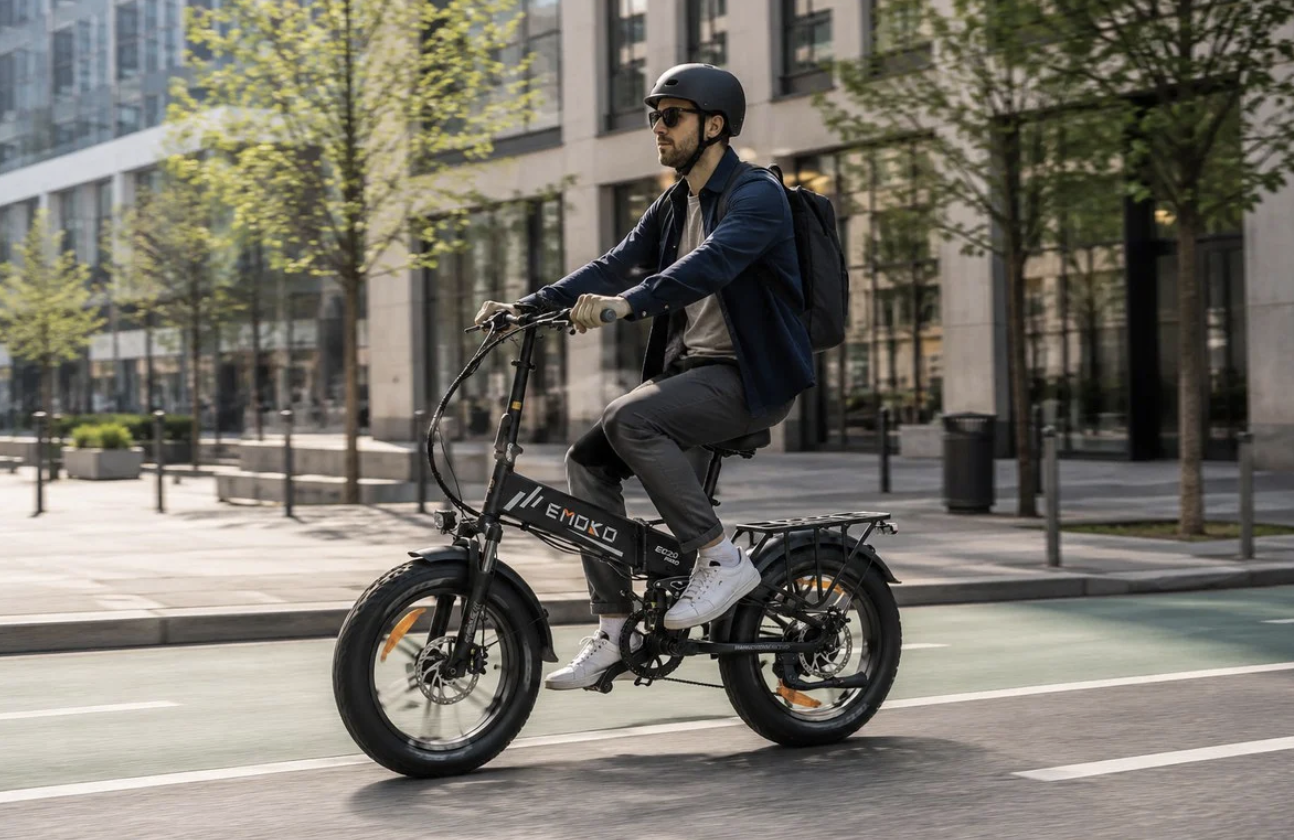
A model such as the Emoko EC20 folding e-bike illustrates how a folding frame and front-and-rear suspension can be integrated into one commuter-oriented platform.
The point is not that every commuter requires full suspension. Riders travelling entirely on smooth roads may prefer a simpler setup. However, people facing broken pavement, gravel shortcuts, or mixed surfaces should consider comfort as a practical requirement rather than a luxury.

Use a Two-Layer Security Strategy
A folding bike is easier to bring indoors, but there will still be occasions when it must be left outside temporarily.
Do not rely on a thin cable lock as the only form of protection. A stronger approach uses one primary lock through the frame and a second device to secure a wheel or another part of the bicycle.
Whenever possible, lock the bike to a fixed object in a visible area with regular foot traffic. Avoid leaving it in isolated locations for long periods.
If the battery and display are removable, consider taking them with you during longer stops. Removing valuable components does not make the bike impossible to steal, but it may make the bicycle less attractive and reduce the financial loss if an incident occurs.
Record the frame number, retain purchase documentation, and take several clear photographs of the complete bicycle and its identifying marks. These records can help with insurance claims, police reports, or ownership verification.
A practical security routine should include:
- choosing a visible parking location;
- using a strong primary lock;
- securing easily removed components;
- limiting how long the bike remains unattended;
- bringing the bike indoors whenever practical.
Carry a Small Commuter Kit
A compact repair kit can prevent a minor mechanical issue from becoming a long walk home.
The kit does not need to be large. For most daily journeys, useful items may include:
- a compact tire pump;
- tire levers;
- a compatible inner tube or puncture kit;
- a bicycle multitool;
- several reusable straps;
- a clean cloth;
- a lightweight waterproof cover;
- a small backup light.
Riders commuting near sunset should check their lights before leaving rather than discovering a problem after dark.
The contents of the kit should match the bicycle. A spare tube must fit the wheel and tire size, while the multitool should include the fasteners used on the bike. Carrying tools that do not fit the bicycle only adds weight without solving likely roadside problems.
Maintain the Folding Points and Moving Parts
A folding electric bike has hinges, clamps, and locking mechanisms that a conventional rigid bicycle may not have. These areas deserve regular inspection.
Check the primary folding hinge for looseness, unusual movement, dirt, corrosion, or incomplete engagement. Make sure the locking mechanism closes fully before every ride. Do not ignore a change in the way the hinge sounds or feels.
The same routine should include the brakes, tires, chain, cables, lights, suspension components, rack fasteners, and wheel security. A short inspection before the working week is usually easier than dealing with a failure during the morning commute.
These folding-specific inspections should be combined with basic bike maintenance habits, including checking tire pressure, lubricating the drivetrain appropriately, inspecting brake wear, and storing the bicycle in suitable conditions.
Cleaning also matters. Dust and road grit can collect around hinges and moving parts. Follow the cleaning method recommended by the manufacturer, avoid directing high-pressure water toward electrical connections or bearings, and dry the bicycle after wet rides.
When a component feels loose, damaged, or difficult to operate, have it checked by a qualified technician instead of repeatedly tightening or adjusting it without knowing the correct specification.
Build a Repeatable Commuting System
The most practical folding e-bike is not necessarily the model with the longest list of features. It is the one that fits naturally into a reliable and repeatable routine.
That routine should answer several basic questions:
- Where will the bicycle be stored?
- When will the battery be charged?
- Which route is safest and most comfortable?
- What security equipment will be used?
- Which tools should travel with the bike?
- When will the hinges, brakes, tires, and drivetrain be inspected?
Once these decisions become habitual, folding stops being a novelty and becomes part of a dependable transportation system.
A folding e-bike can reduce dependence on parking, shorten the last mile, and make mixed-mode travel more manageable. Its daily value, however, comes from the complete system surrounding it: sensible route planning, secure storage, safe charging, appropriate comfort, layered security, and consistent maintenance.
 Email
Email