Gas Mini Bikes for Adults: Weight Limits, Real Speeds, and Where You Can Ride
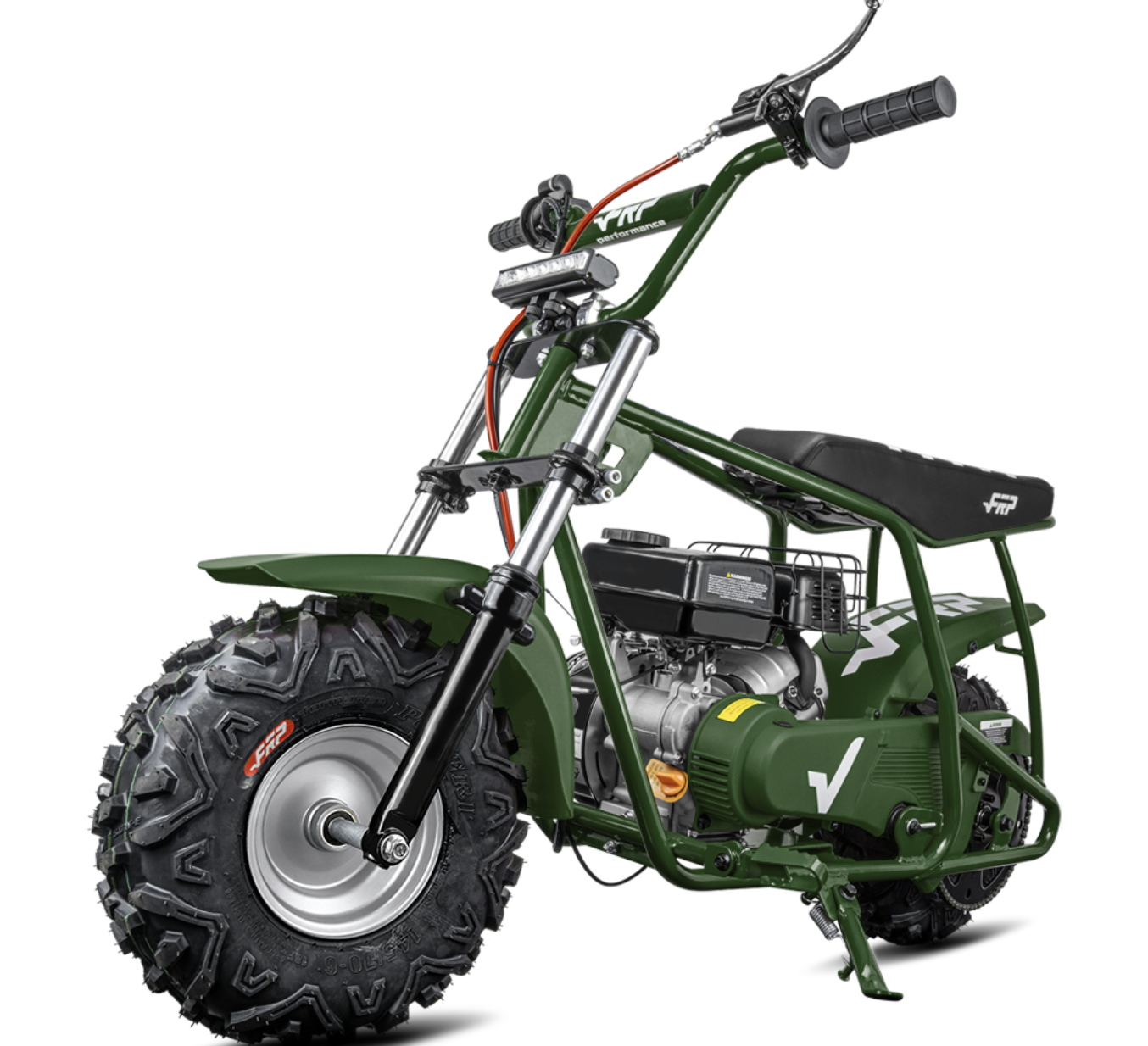
Compare gas mini bikes for adults by weight limit, stock speed, terrain and legal use. See when the FRP GMB100 or GMB100P fits your riding needs.
Most mini bike guides are written around children, but many buyers are adults looking for a compact gas-powered machine for private property, farm lanes, campsites and light trails.
For those buyers, engine size is not the first question. The useful questions are:
- Will the bike support the rider?
- How fast does it run in stock form?
- Is it built for smooth ground or rough terrain?
- Can replacement parts still be found later?
- Where can it legally be ridden?
A larger engine does not automatically mean a better adult mini bike. Gearing, vehicle weight, suspension, brakes and factory speed limits all affect how the bike feels in actual use.
Start With the Published Weight Limit
Adults should check the manufacturer’s listed load rating before looking at top speed.
Many compact gas mini bikes are designed around rider limits near 200–220 lb, although the exact figure varies by model. An unpublished limit should not be treated as unlimited capacity. It means the buyer needs to check the manual or confirm the rating with the seller.
The FRP GMB100 gas mini bike lists a 220 lb maximum load while the bike itself weighs 79.5 lb. That combination suits riders who want a compact machine that is easier to move, load and store than many larger-engine mini bikes.
A published load rating is not a guarantee that every rider below the number will fit comfortably. Height, inseam, strength and experience still matter. It is also not a reason to exceed the stated limit. Riders above the manufacturer’s capacity should move to a larger motorcycle, ATV or UTV designed for the load.
Stock Speed Is Not Determined by CC Alone
Mini bike speed depends on more than displacement. Gearing, clutch design, tire size, vehicle weight and factory limiting can matter as much as engine size.
That is why some 99cc bikes can run faster in stock form than heavier 196cc models that are limited from the factory, while performance-oriented 196cc and 212cc machines may still be quicker overall.
The GMB100 uses a 99cc four-stroke engine and has a listed top speed of 24 mph. It uses an automatic clutch and pull start, so there is no hand clutch or manual shifting to learn.
For adults using a mini bike around a yard, farm lane or private trail, a manageable stock speed may be more useful than the largest engine number available. Actual speed will still vary with rider weight, terrain, maintenance and riding conditions.
The Main Market Choices
Adults generally compare four types of gas mini bikes.
Lightweight 79cc–105cc Mini Bikes
These are easier to move, store and transport. They usually suit yards, packed dirt and light trail use rather than riders looking for maximum performance.
The GMB100 sits in this group, but with a published 220 lb load rating and a lighter 79.5 lb bike weight.
Big-Box 196cc Mini Bikes
These offer more displacement, broad aftermarket support and, in some cases, local retail availability. They are normally heavier, and stock speed varies because some models are factory limited.
They make sense for buyers who value engine size, modification options and local availability more than portability.
212cc Performance Mini Bikes
These are the stronger choice when stock acceleration and speed are the priority. They are usually heavier and may be less convenient to load, store or move by hand.
Low-Cost Marketplace Imports
These can offer a low entry price, but specifications, load ratings, manuals, warranty coverage and parts support vary by seller. Buyers should verify the exact model rather than assuming similar-looking bikes use the same parts.
This is where FRP’s position becomes clearer. It is not trying to offer the largest engine in the class. It offers a lighter 99cc platform with a published load rating, documented specifications and two versions built for different terrain.
Choose by Terrain, Not by Price
The practical difference between FRP’s two 99cc mini bikes is not “basic versus premium.” It is smooth ground versus rough ground.
GMB100: Flatter, Smoother Ground
The GMB100 has:
- a rigid steel frame;
- a listed top speed of 24 mph;
- a 220 lb maximum load;
- a 79.5 lb net weight;
- a rear disc brake;
- 13-inch off-road tires;
- a listed range of up to 30 miles.
It is the more direct choice for yards, farm lanes, packed dirt and relatively smooth private trails. Its lower weight also makes it easier to move in and out of storage or load into a suitable vehicle.
GMB100P: Rougher Ground
The FRP GMB100P uses the same 99cc engine and carries the same listed 220 lb maximum load, but it is configured for more uneven terrain.
It adds:
- a front suspension fork;
- hydraulic disc braking;
- all-terrain tires;
- a reinforced P-frame;
- 2.0 heavy-duty rims;
- a listed top speed of 28 mph.
Those differences matter on gravel, roots, ruts, bumps, and sections with repeated braking. The reason to choose the GMB100P is that the terrain uses the suspension, tires, and braking, not because every rider automatically needs the more equipped model.
A rider staying mostly on flat, smooth ground may be better served by the lighter GMB100. A rider regularly crossing rough trails may benefit from the GMB100P every time the bike is used.
Why Weight and Portability Matter
Vehicle weight affects the entire ownership experience, not just riding.
Before buying, ask:
- Can one or two people load it safely?
- Will it fit in the planned truck, trailer or storage space?
- Can the rider move it when the engine is off?
- Can it be recovered after a tip-over?
- Will it need to be loaded and unloaded often?
At 79.5 lb, the GMB100 is easier to handle off the bike than many larger-engine machines. The GMB100P is listed at 86 lb, adding suspension and rough-terrain equipment without becoming a full-size motorcycle.
For property use, camping and weekend trail riding, portability may matter more often than extra displacement.
Brakes and Suspension Should Match the Surface
A rigid-frame mini bike is not automatically inferior. On smoother ground, it is simple, light and predictable.
Suspension becomes more valuable as the terrain grows rougher. A front fork can reduce the impact transmitted through the handlebars when crossing bumps, roots and ruts.
Braking needs also change with the surface. Loose gravel, repeated downhill braking and uneven trails place different demands on a bike than short laps around a level yard.
This is why the GMB100 and GMB100P should be treated as two terrain-specific choices rather than a low model and a high model.
Parts Support Matters After the First Season
Top speed attracts attention before the purchase. Parts availability matters afterward.
A gas mini bike will eventually need routine items such as a chain, brake components, tires, a spark plug, a throttle cable or other visible hardware. These are normal service items, but even a small repair can park a bike if the owner cannot identify or obtain the correct part.
Before buying, ask:
- Is there a model-specific parts page?
- Is a user manual available?
- Can the seller identify compatible replacement parts?
- Is there a direct support channel?
- Are warranty and return terms published?
- Do modifications affect coverage?
FRP Moto publishes model-specific information, replacement parts, manuals and direct support channels. That does not replace a nationwide dealer network, but it gives owners a defined place to start when maintenance or troubleshooting is needed.
This is the meaningful difference between a documented direct-to-consumer brand and a marketplace listing whose seller, specifications or parts availability may change later.
Where Can Adults Legally Ride a Gas Mini Bike?
Do not assume a gas mini bike is street legal.
The GMB100 and GMB100P are intended for off-road recreational use. Appropriate locations may include private property with permission and approved off-highway vehicle areas, depending on local law.
Rules vary by state, county and municipality. A headlight, adult rider or larger engine does not automatically make a mini bike legal on public roads.
Before buying, confirm:
- whether the intended property allows gas-powered vehicles;
- whether OHV registration is required;
- whether age or helmet rules apply;
- whether the seller ships the model to the rider’s state;
- whether local noise or land-use restrictions apply.
Choosing Honestly
Choose a larger 196cc- or 212cc-class mini bike when engine size, stronger stock performance or a large aftermarket is the main goal and the additional weight is acceptable.
Choose the GMB100 when:
- the rider is within the listed 220 lb limit;
- the ground is mostly flat or smooth;
- a lighter bike is easier to store and transport;
- 24 mph suits the intended riding area;
- simple automatic operation is preferred.
Choose the GMB100P when:
- the rider is within the same listed load;
- the route includes gravel, roots, ruts or repeated bumps;
- front suspension is useful;
- stronger braking control is needed;
- 28 mph suits the riding area.
Choose neither when:
- the rider exceeds the published load;
- the intended use is public-road transportation;
- the riding area does not permit gas mini bikes;
- the buyer needs a full-size motorcycle seating position.
FAQ
What Is the Weight Limit on a Gas Mini Bike for Adults?
It depends on the model. The GMB100 and GMB100P each list a 220 lb maximum load. Other mini bikes may publish lower, similar or no clear ratings. Always use the current manufacturer specification rather than assuming engine size determines carrying capacity.
How Fast Does the FRP GMB100 Go?
The stock GMB100 has a listed top speed of 24 mph. Actual speed depends on rider weight, terrain, maintenance and riding conditions.
GMB100 or GMB100P—Which One Should I Get?
Pick by terrain, not by price. Choose the GMB100 for a yard, farm lane, packed dirt and smoother private trails. Choose the GMB100P for gravel, roots, ruts, bumps and riding that benefits from front suspension, hydraulic braking and all-terrain tires.
Is the GMB100P Simply an Upgraded GMB100?
No. It uses the same engine class and the same listed 220 lb load rating, but it is configured for a different environment. The GMB100 is the lighter rigid-frame option for smoother ground. The GMB100P is the rough-terrain option.
Are Gas Mini Bikes Street Legal?
Do not assume they are. The FRP models discussed here are intended for off-road recreational use. Check state and local rules before riding anywhere other than permitted private property or an approved off-road area.
Can Adults Ride a 99cc Mini Bike?
Yes, when the manufacturer’s load rating, rider fit and intended use are appropriate. A 99cc engine does not automatically mean a bike is only for children. The GMB100 and GMB100P list a 220 lb maximum load, but the rider must still be able to control the bike safely.
Can I Install a Larger Engine Later?
Engine swaps are aftermarket modifications. They may require changes to mounting, clutch and chain alignment, braking and other safety components, and they may affect warranty or compliance. Treat an engine swap as an experienced-builder project, not a standard ownership step.
The Bottom Line
Adults should not choose a gas mini bike by engine size alone.
Start with the published load limit. Then compare stock speed, vehicle weight, terrain, brakes, suspension, parts access and local riding rules.
For FRP’s 99cc models, the distinction is practical:
- choose the GMB100 for flatter, smoother ground;
- choose the GMB100P when suspension, stronger braking and rough-terrain control will be used regularly.
The right mini bike is not the one with the largest engine number. It is the one that fits the rider, matches the terrain and can still be supported after the first season.
 Email
Email