Pilates for cyclists: Stronger legs without overloading the back
Strong legs do not automatically guarantee efficient cycling. More and more cyclists are noticing that despite good endurance, the body starts limiting performance through lower back pain, tight hips or neck tension during longer rides. In many cases, the issue is not a lack of strength but insufficient core stability and poor pelvic control in a forward-leaning position.
A well-structured Pilates practice improves the way force transfers from the centre of the body into the pedals. Both mat training and Reformer Pilates increase core stability, improve hip mobility and teach the body to generate strength without overloading the lumbar spine. As a result, the body works more efficiently and power no longer “leaks” through an unstable torso. For many cyclists, the biggest improvement is not stronger legs — it is riding without constant back tension.
How Pilates improves stability while cycling
During cycling, the pelvis should remain stable despite the dynamic movement of the legs. When the deep stabilising muscles do not activate early enough, the body starts searching for stability in the lower back. This is when overload, stiffness and reduced pedalling efficiency begin to appear.
Pilates teaches the body to activate stabilisation before the movement begins. This means the core stabilises itself before the leg pushes into the pedal. The body regains control over the ribs, pelvis and spinal alignment. As a result, force generated by the legs transfers more efficiently, while the lumbar spine no longer acts as an emergency stabiliser.
Why cyclists experience back pain despite strong legs
Strong quadriceps and well-developed glutes do not guarantee freedom from overload. Cycling requires maintaining a flexed position for many hours, gradually increasing tension in the front of the hips and reducing thoracic mobility. The body then compensates for this lack of mobility by overloading the lower back.
This is why many cyclists experience pain despite being in excellent physical condition. The issue often comes from a lack of structural balance, not from cycling itself. Pilates improves thoracic mobility, activates stabilising muscles and restores pelvic control. The spine stops taking over movements it was never designed to perform.
Reformer Pilates improves power generation
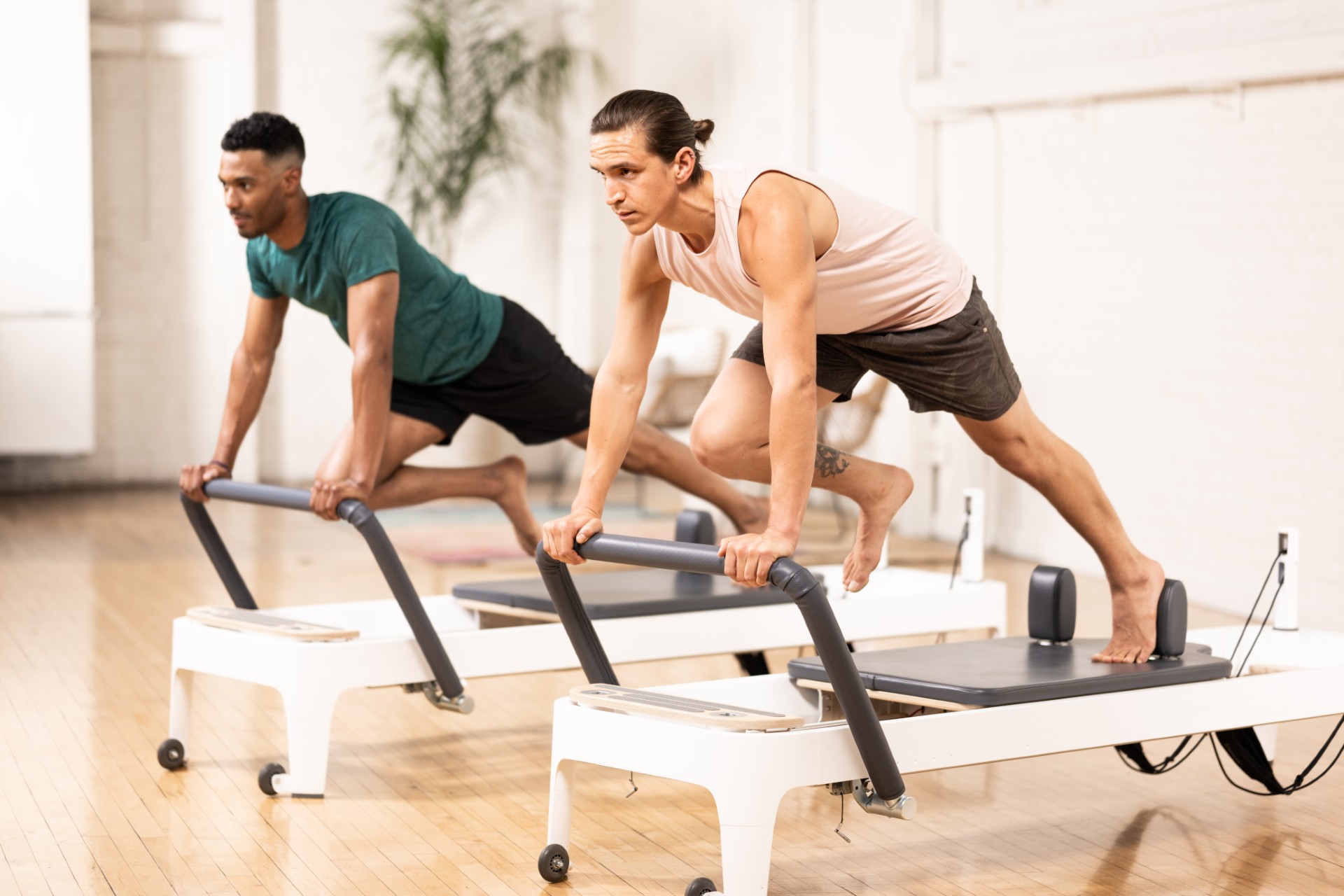
The reformer allows the lower body to train in a way that closely resembles the mechanics of pedalling. The platform moves under pressure from the feet while the torso must remain stable at the same time. This teaches the body to generate force without losing control over the pelvis and lumbar spine.
Another major benefit is the ability to progressively increase resistance. The springs allow training intensity to rise without compromising movement quality. The glutes begin working more efficiently, while the nervous system synchronises core stability with lower limb movement. Power is no longer lost through uncontrolled torso movement.
Hip mobility affects cycling efficiency more than most people realise
Tight hips significantly reduce riding comfort. A body that cannot access proper hip range of motion starts compensating through excessive movement in the lower back. This increases spinal overload and reduces pedalling efficiency.
Pilates improves mobility actively. The body not only increases range of motion, but also learns how to control it. The hips begin moving more fluidly, while the pelvis maintains a more stable position during effort. This allows the body to generate force without excessive tension in the lower back and neck.
How Pilates affects breathing during cycling
Breathing has a major influence on stability and endurance. Many cyclists breathe very shallowly, especially during intense efforts or aggressive riding positions. The neck and shoulder muscles then begin compensating for breathing, increasing tension throughout the body.
Pilates improves thoracic mobility and diaphragm activation. The body starts breathing more deeply and calmly, even during physical effort. This improves riding comfort and reduces fatigue in the accessory breathing muscles. The body stops wasting energy on unnecessary tension.
The biggest Pilates benefits for cyclists usually include:
- improved core stability during pedalling,
- reduced overload in the lower back,
- increased hip and thoracic mobility,
- better breathing control during effort,
- more efficient force transfer into the pedals,
- reduced neck and shoulder tension.
A Pilates reformer supports pelvic control while riding
The pelvis is one of the most important stabilising elements in cycling. If it remains unstable, the body begins creating micro-movements in the lumbar spine with every stronger pedal stroke. This leads to overload and unnecessary energy loss.
A professional Pilates reformer allows highly precise work on pelvic control during movement. The body learns how to maintain a stable torso despite dynamic leg movement. As a result, force generated by the lower limbs becomes more efficient, while the body experiences less fatigue during long rides.
Pilates improves movement efficiency while cycling
Endurance is not only about muscular power. The way the body manages tension also plays a huge role. A tense, overloaded body consumes more energy even at similar effort levels. Movement becomes less fluid and muscles fatigue faster.
Pilates improves coordination and movement awareness. The body starts activating muscles more precisely instead of maintaining constant protective tension. This allows the body to work in a lighter, more efficient way. The difference becomes especially noticeable during long rides and climbs.
Why a Pilates studio complements cycling training so well
Cycling is based on highly repetitive movement. During a single ride, the body performs thousands of similar movement cycles, making it easy to reinforce overload and asymmetries. Pilates helps address the elements often missing from cycling training itself.
A good Pilates studio allows exercises to be adapted individually to the body’s needs. The instructor can observe pelvic alignment, scapular control and breathing mechanics throughout movement. This helps the body restore structural balance faster and better tolerate training loads.
Pilates equipment helps prepare the body for cycling season
Preparing for cycling season should not rely solely on increasing training volume. The body also needs stability, mobility and proper recovery. These elements often determine comfort and efficiency during longer rides.
Professional Pilates equipment allows the body to build strength and movement control without overloading the joints. The body can work intensely while maintaining smoothness and stability. This helps the body adapt more effectively to increasing training demands.
Regular Pilates supports cyclists on multiple levels:
- improves the quality of core stabilisation,
- increases pedalling efficiency,
- helps reduce back pain during cycling,
- improves hip and thoracic mobility,
- supports nervous system recovery,
- increases comfort during long rides and climbs.
Pilates helps cyclists unlock the full potential of their legs
Many cyclists focus mainly on developing lower-body strength. However, the body needs a stable centre in order to use that power efficiently. Without torso control, part of the energy is lost through unnecessary pelvic movement and spinal overload.
This is exactly why Pilates complements cycling training so effectively. The body starts generating force more economically and with less protective tension. The body does not work harder. It works smarter.
This article was created in collaboration with balanced-body.lt